Colloqui di Fisica: The Climate System as an Inverse Problem: Data Assimilation, Reanalysis and the Future of Climate Intelligence - Dipartimento di Economia Aziendale
Colloqui di Fisica: The Climate System as an Inverse Problem: Data Assimilation, Reanalysis and the Future of Climate Intelligence
Link identifier archive #link-archive-thumb-soap-54461
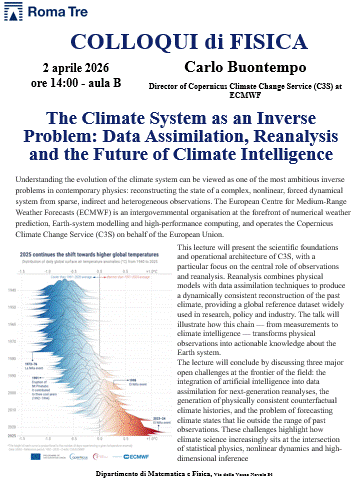
Giovedì 2 aprile 2026 alle ore 14:00, il Prof. Carlo Buontempo Director of Copernicus Climate Change Service (C3S) at ECMWF terrà il Colloquio di Fisica dal titolo "The Climate System as an Inverse Problem: Data Assimilation, Reanalysis and the Future of Climate Intelligence".
Abstract: Understanding the evolution of the climate system can be viewed as one of the most ambitious inverse problems in contemporary physics: reconstructing the state of a complex, nonlinear, forced dynamical system from sparse, indirect and heterogeneous observations. The European Centre for Medium-Range Weather Forecasts (ECMWF) is an intergovernmental organisation at the forefront of numerical weather prediction, Earth-system modelling and high-performance computing, and operates the Copernicus Climate Change Service (C3S) on behalf of the European Union. This lecture will present the scientific foundations and operational architecture of C3S, with a particular focus on the central role of observations and reanalysis. Reanalysis combines physical models with data assimilation techniques to produce a dynamically consistent reconstruction of the past climate, providing a global reference dataset widely used in research, policy and industry. The talk will illustrate how this chain — from measurements to climate intelligence — transforms physical observations into actionable knowledge about the Earth system. The lecture will conclude by discussing three major open challenges at the frontier of the field: the integration of artificial intelligence into data assimilation for next-generation reanalyses, the generation of physically consistent counterfactual climate histories, and the problem of forecasting climate states that lie outside the range of past observations. These challenges highlight how climate science increasingly sits at the intersection of statistical physics, nonlinear dynamics and high-dimensional inference.